True Confession: The Well is Dry. Help!

From Susan Mermaid.

Okay, friends.  It’s time for true confessions.  I’ve tossed and turned and I’m out of excuses but here it is:

I have not written a page since NaNo ended.

November and NaNoWriMo were crazy.  It was thrilling and scary and fun, all at the same time. I threw myself at that project with everything I had. Wrote at a pace I didn’t remember ever achieving.  And I produced!  For me, an astonishing 18,000 words in a month.  And it was killing me.

By late November, I could feel the effect – no, not the boy, howdy I’m writing at a pace I never have before!  More the oh crap, I can’t live like this, what was I thinking?  And the inner voice that said keep it up kid, and you’ll have a complete manuscript in no time! had changed its tune to slow down, or your doctors are going to shaking their heads.  Your body is not meant for this.  I mean it.  MS is the cruel cousin who drops in for a visit, smashes all the prettiest dishes you own and leaves you to clean up the mess with no broom.

So, when December rolled around, I was more than ready for a break.  A week, I told myself.  That became two.  And then the holidays.  And New Year’s eve.  And then school started again and we were back to the races with work!

Now it’s February, I’ve forgotten most of what I’d intended to write, my story seems sad and my characters are dead to me.   The well is dry.  Try as I might, it refuses to be pumped.  Every day (just like my promise to get on the treadmill more often) I find another excuse.

So here’s my confession:  I’m a turtle writer.  I don’t have stories pouring out of my fingertips and I’ve got a lot more on my mind than writing on most days.

So before I let those voices of you faker, you aren’t a writer, you’re just a wannabe win, I’ll ask you:

How do you slay the fear of doom and nurture the well of creativity?  Susan-Mermaid-avatar

Today is The Official Writers Vacation Monday (and Giveaway Winner Announcement)

IMG_0073by Denny S. Bryce

Hanging out with writers this weekend (had a marvelous time btw), I decided it was time to take a vacation. No, not because I need a vacation from writers:). It’s just that writers juggle so much, work so hard, and think (all the time we are thinking, thinking, thinking) that I have decided to declare Monday, February 11, the  OFFICIAL WRITERS VACATION MONDAY. And not just a day to take a break from the day-to-day either. Pack your bags we are heading to an island! That’s right. (okay, it’s photo day, but you know, use your imagination, I am:). We’re going on a dream vacation. And today’s official writers monday destination is Maui. Okay? You in?

Here we go! () Continue reading

Tawny Weber (aka Hot Sassy Romance Author) dips a toe in the water!

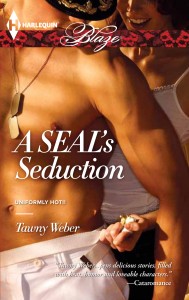
From Mermaid Susan:  The Mermaids are delighted to welcome author Tawny Weber to talk about her titles A SEAL’s Seduction, and its equally hot companion, A SEAL’s Surrender, both from Harlequin  Blaze.

  • Welcome to the lagoon, Tawny!  Tell us a bit about yourself and how you came to embrace the writing life.

Thank you for the lovely welcome! And what a nice lagoon you have here!  Can I get a frothy drink in a coconut shell?  I’m a fan of froth.  🙂

Here ya go!

I love the writing life. But I wasn’t one of those gifted writers born to it, or even one who discovered it in their early years.  Growing up, though, while so many friends worshipped actors or rock stars, my pedestals were all saved for authors.  I love books.  But it wasn’t until my husband asked me what I’d do if I could have any dream career that I even considered writing.  Once he’d prodded me in the right direction, I embraced the idea.  It took me 4 years and 6 books to get a strong enough handle on the craft, my style and find the right story to sell.

  • A SEAL’s Seduction is part of a series.  What is already out and WHAT COMES NEXT?

 A SEAL’s Seduction and A SEAL’s Surrender are a very sexy pair of Uniformly Hot Blaze novels.  A SEAL’s Seduction is Blake’s story – a good boy with a penchant for following the rules.  Until he meets a woman who makes them all worth tossing away.  He’s debuting on bookshelves this month (2/13). His best friend and fellow SEAL, Cade, will be on the shelves next month (3/13).  Unlike Blake, Cade is a lady’s man.  He’s got that slick, sleek appeal that makes women swoon.  Which becomes a problem when one of the swooning women turns out to be his favorite girl next door.

  • One of your recent blog posts discussed the use of theme in your story, and how you consciously used it in planning A SEAL’s Seduction.  Can you explain some of that thought process to our readers?

This was actually a different process for me, as I’m not an analytical reader or writer by nature.  I’m never strategic and don’t tend to see that big picture that theme usually embodies.  But A SEAL’s Seduction was one of those blessing stories.  The kind that just arrive in your head, fully formed with the scenes all crystal clear and the characters alive and dancing.  Because I could see the story so clearly, the contrasts were just as clear to me.  Hot and cold.  By simply keeping that contrast in my mind while I wrote, I was able to mirror a lot of the story elements between the first and second halves of the book.  In the first, she eats chocolate ice cream, in the second, it’s hot chocolate, for instance.  In the opening, Alexia welcome the concept of a hot, exciting relationship. She’s warm and caring, while Blake is hurt and closed off.  That switches in the second half of the story, while the setting changes from sunny San Diego to frozen Alaska.

The theme and contrasts aren’t overt or major forces in the story, but they were fascinating to weave into the elements as a supporting thread.

  • Most of us know nearly nothing about the world of Navy SEALs.  How did you do your research?

My husband is ex-military, so I relied on his expertise and research capabilities a lot.  And I spent a lot of time online staring at hunky pictures of military heroes *g*.  Yes, that is research!!

  • Plotter or pantser?

Plotter!  I need a solid direction when I write.  A map, if you will.  I never know exactly what the scenery or sights will be on the trip, but I have to know the destination, who’s driving the car and where the major stops will be.

And I love plotting boards.  The colored sticky notes appeals to my office-supply addiction *g *

  • Hot writing.  WOW.  Do you have a secret weapon for getting women to fan themselves?  Discuss.

We like looking at hot guys, too!

LOL –well thank you!  I’m glad you found it WOW-worthy.  I wish I did have a secret weapon!  And if I did, I wish I’d always remember to keep it in the same place so I could find it again next time.

But, sadly, no.  I write the love scenes the same as I write the humor and the suspense elements of my stories.  By focusing on the main characters and trying to stay true to their personalities, their issues and their fantasies.  Hopefully, that translates into characters that readers can connect with, ones they empathize with.  If a reader can see and feel the story through the characters’ eyes, then they will see and feel the same things that character is going through.  Which means if the love scene is hot enough to get the character all worked up, then the reader is on board, too.  🙂

At least, that’s the hope.

  • A little about your writing day?  What’s the weirdest thing in your writing space?  The most important to your writing karma?  (thanks to CTRWA’s February newsletter for this idea)

Oh wow, cool question.  I love the idea of writing karma.

So, lets, see. My writing day is really the middle of the night.  I started writing when my youngest was only 2, which meant my days were very busy and night was the only time I had to focus.  Most nights, I start writing around 10pm, after everyone has gone to bed.  I keep going until about 3am, unless I’m against the deadline wall or the story is flowing like crazy.  Those days are usually the ones that my husband finds me at my desk when he leaves for work in the morning *g

The weirdest thing about my writing space.  I’m looking around, but it all looks normal to me LOL.  I guess the weirdest would be that my office opens up from two doors – one has a view of the long hallway and loft area above the living room.  The other is to my bedroom.  And I never shut doors, so there is no such thing as privacy in my writing space.

Like these? Yum.

And oh wow –Writing Karma.  I think the most important thing for me, personally, is to remember that beyond any writing or career goals, it’s all about writing the story for the readers.  To bring them joy, satisfaction, happiness or just a good time for a few hours.  If that intention is in place with every story, then I believe that karma will find a way to return the same joy, satisfaction and happiness in return.

  • What is the best writing advice you ever received?  The worst?

The best writing advice I ever heard was to write what you love to read.  We spend an awful lot of time with a story, we should try to find a way to enjoy every second of it.    The worst, I think, was to accept realistic limits.  While I’m all for keeping it real, I’m not a fan of limits.

  •  Are there any teachers, books or courses that helped you refine your craft?

I love Romance Writers of America.  I’ve taken so many workshops and classes and met so many amazing writers through that organization.   In the beginning of my writing adventures, RWA provided the most instruction opportunities.

  • Do you or did you have a life beyond writing?  Crafts or hobbies?  Do they distract you now or offer a chance to unwind?

What’s this thing of which you speak?  Life?  Beyond writing?  LOL.  Actually, I try to keep life pretty balanced.  I don’t actually do it well, but I try.  My favorite hobby and other life-obsession is scrapbooking.  I do card making, too, but the scrapbooking of memories is my favorite thing.  I like to have a project going while I write, so when I get stuck on a page or scene, I can leave my desk and go play with paper and embellishments.  The act of creating in a different medium, especially such a visual one, always seems to shake loose whatever is stuck.  So after a ten, twenty minutes I’m able to go right back to writing with the scene unstuck and my scrapbook project closer to finished.

  • Last, but not least, please tell us about your path to publication.   Especially for our unpublished readers, how long had you been writing  before The Call, and did you ever wonder how it would take for the editors to wake up and see your brilliant talent? (heh heh heh)
I was always focused on writing for Harlequin, first for Temptation, and then when the line closed shifting my attention to Blaze.  It took me 4 years, 5 manuscripts and 3 Golden Heart finals from starting to write to my first sale.
                                                   
This entry isn’t complete without a sincere note of gratitude to
the Navy SEALs
and all the men and women serving in the Armed Forces of the United States.
Your work keeps us free.  Thank you.
                                                                                                       
         Just one more!  (So much fun!  Thank you Tawny, for stopping by!)
  

Tawny Weber has been writing sassy, sexy romances since her first Harlequin Blaze hit the shelves in 2007.  A fan of Johnny Depp, cupcakes and color coordination, she spends a lot of her time shopping for cute shoes, scrapbooking and hanging out on Facebook.

Tawny Weber & dogs 2012

Readers can check out Tawny’s books at her website or join her Red Hot Readers Club for goodies like free reads, complete first chapter excerpts, recipes, insider story info and much more.  And for a limited time, she has a few open spots on her Street Team!

A SEAL's Seduction cover


Tick-Tock, Tick-Tock

Ticking Clock

Good morning fishy friends!  I’m actually going to blog about “writing” today on my group writers blog and not cute boys or cute boys or cute boys.  And that is because it’s contest judging time for my local writing chapter’s annual unpublished writing contest, WRW’s Marlenes.  This is my second year judging and the entries I received this year were very impressive.  There wasn’t a single head hop which stood out to me because I can admit that was my biggest mistake when I first entered my own submission.  More positives were that the characters were all well written and likeable.  The premises were all genuinely unique and interesting.  And there were some really good synopsis’ included at the end.

If the stories I read lacked anything, it was a clear understanding of the Ticking Clock.  I pulled this definition from Mary Buckham and Dianna Love’s power plotting book, Break Into Fiction.  The Ticking Clock is “an internal or external element in the story that creates a limit to how much time the character has to complete his or her immediate external goal.”

Have you ever been reading a book or a contest entry and everything is going just fine.  You’re enjoying the story well enough, but pretty soon, you start to wonder why is it so important that this is happening?  The material is good, but it’s not exciting you to keep turning the pages.  It could be because of that missing ticking clock.  I’m going to go ahead and refer to this little guy as Tik Tok (Return to Oz).

What Tik Tok does for your story:

-Gives your story purpose, urgency & excitement

-Assures good pacing, making it a page turner

-It doesn’t have to be “in your reader’s face”

That last point is important because I got to thinking that for a contemporary genre writer, you may not have exploding bombs to diffuse or kidnapped victims to rescue before time runs out.  Maybe your Tik Tok is a high school reunion the heroine has to be ready for or maybe your heroes are rockstars and you have a band about to go out on the road and tour.  My current WIP’s Tik Tok is the pending birth of a baby–the hero and heroine want to be free of their demons before this new life enters the world in two weeks. See, completely normal life events but important enough to get one’s butt in gear!

Whatever the element creating that time limit for your story is, it MUST be essential to your character’s pending goal.  It has to be detrimental enough to ignite them to do whatever they have to do to meet that end.

Often I think the author probably has this in their head but fails to weave it into their story early on.  Most contest entry lenghts I read this past week took me to about the third or fourth chapter.  As the reader, I should feel the pressure urging your characters on by that point.  The earlier the better in fact.

To find your Ticking Clock, ask yourself why it’s so important for the characters to be accomplishing whatever it is they are doing in a timely manner.  The Tik Tok is the motivator to this happening.  They have a goal.  It’s essential that they accomplish it.  Now what candle are you going to light under their butt to move them to action?

Fishy kisses signed, sealed and delivered, on time!Mermaid Carlene


Today? You’re Dead To Me

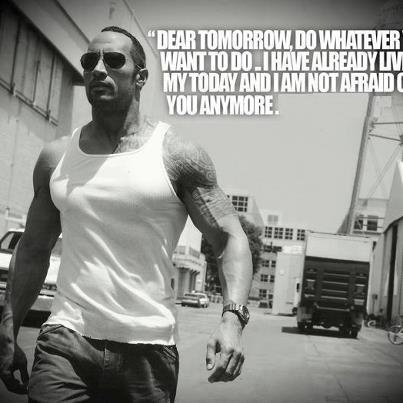
I don’t know about you, but this is how I try to start my day. At least after the first twelve cups of coffee.

therock

But there are days that pick me up by the red highlights and tosses me around like a mouse being thrashed to death by an alley cat.

And I want to do this to the day:

crazy-funny-gifs-groundhog-day-punch

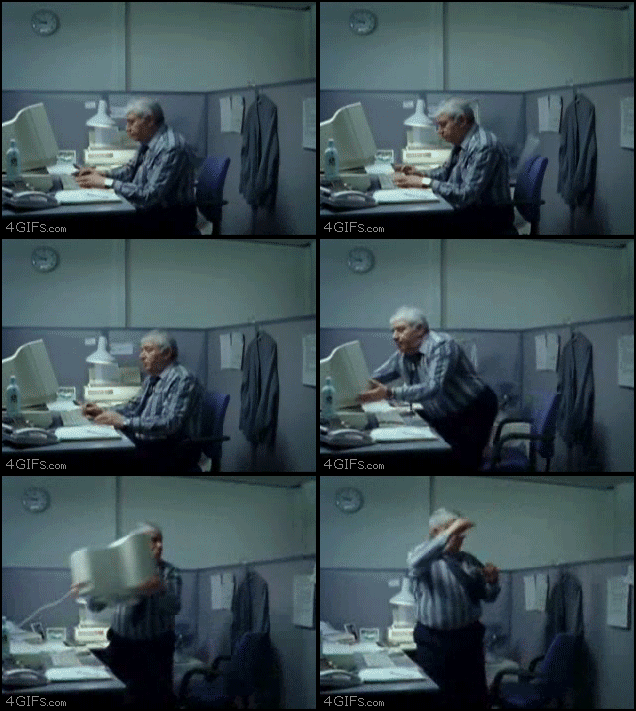
Then, someone does something that normally would make me giggle – or at worst roll my eyes – and I overreact like this (sorry Denny):

7172012053449workingattheoffice

As we all know, a good friend will call you on your bullshit. And when she does (thank you Denny) I’m as embarrassed as if I’d just gotten caught doing this:

tumblr_ll3jgmsPho1qzbiyjo1_500

But it’s all good, because that helps me get to that place where I can do this:

1237977238_pineapple-express-laughing

OK, I’m not gonna lie. I can do that because of a little help from this:

Cat-DrinkingBeerWatchingtv

and good friends who commiserate with me like this (thanks Robin and Kim):

friends-omg

Finally, I beat that awful day in a dance off.

an-DancingGuys

Then, I wake up and it’s a new day. Damn it, I will own it. You will too.

ivana-hong-dance-moves-i-am-win2

Healing Hands

Princess Alethea MermaidAs I mentioned last month, among my resolutions for 2013 were a few “Internal” goals. One of these goals I actually cheated and started before the New Year, mostly because I was in ghastly amounts of pain.

That’s right — I booked a massage.

Right now you’re thinking, “Oh, Alethea. What is wrong with you? It’s not terrible to book a massage, you selfish thing!” Part of me thinks that too. In fact, I thought that for so long, I never actually GOT a massage, because I was worried that I would fall in love with it and then never be able to afford it again. All I knew about massages I read in books and saw in movies. They looked like wonderful, magical things…especially for a writer with chronic neck & shoulder stiffness.

A few years ago, I tried a 30-minute chair massage.
I was in severe pain for the next three days.

I tried chair massages twice after that, thinking that it was ood for me, working out these muscles. Now, I’ve had whiplash from riding Outer Limits (now Flight of Fear) at King’s Island. The pain I felt after every chair massage was ten times worse than whiplash.

I did a lot last year — driving myself 2500 miles around the southeast for my own book tour, then sitting down to write an entire novel, all the while still attending conventions and Comic Cons every other week. I saw a chiropractor and hated every minute of it. By Halloween, I’d lost feeling in my right armpit. I bought a coupon for a local Yoga studio online…and then promptly got sick. By Christmas, I decided to make the call. I was prepared for the pain.

A month and three massages later, I’m here to tell you: I have found a new way of life. I’m sleeping better and have fewer headaches. Luis, my masseuse, is my new favorite person. This is one resolution I mean to keep.

If you have never had a table massage before, here are some helpful things to know:

1.) A chair massage and a table massage are totally different. A chair massage can be done in a mall. A table massage is done in a private room, with low lighting and soothing music. It’s amazing what a difference ambiance makes. The more relaxed you are, the better your massage will go. My massages were performed on a heated table, and were a million times less painful than my experience in The Chair.

2.) Get naked. This is really the perfect opportunity to get over all those hang-ups you might have with your body. What the masseuse needs you to be is a lump of dead weight on the table–he or she will move your arms and legs and head as needed. You are under layers of bedsheets, and the masseuse reveals only what he/she needs to, folding and tucking the ends under your body so nothing comes loose. It’s  very professional and discreet.

On my first visit, I kept envisioning myself as a big fat mob boss with a cigar, like in the comic books. THEY don’t care what they look like, and those guys get massages ALL THE TIME. (Plus, when your masseuse finds that magical pressure point in your size-14 butt that clenches around your sciatic nerve after sitting in a chair for 9 hours, you will be so happy you won’t even care.)

3.) Communication is key. Be sure to let your masseuse know up front that this is your first time. He or she will help guide you through things (like when it’s time to flip over). Ask any questions you like and bring up any concerns you might have before it all starts. No need to overshare–just tell them if you have areas you’d like them to concentrate on. They’ll find the rough spots, even the ones you don’t know about.

Then it’s time to shut up and relax. Relaxing is difficult for me, so it requires concentration. Similarly, your masseuse is doing the equivalent of seeing inside your body with their hands. They need to concentrate as well. Of course, if you are feeling unbearable pain, let your masseuse know immediately. It’s okay to feel uncomfortable as they work on those rough patches, but pain is not the goal.

4.) There are different types of massage. Books and movies teach us to be scared of “deep tissue” and anything that involves someone walking on your back. Massages can range from 1-10, 1 being Relaxation Massage and 10 being Deep Tissue. The massages I get are “Therapeutic Massages,” which are at about a 7 or 8. In Therapeutic Massage, there is a lot of work done with thumbs and forearms. With Deep Tissue, it’s all elbows. Communicate to your masseuse about the level of massage you desire.

5.) Tip well. Yes, massages are expensive, and I balked when I realized that I was expected to fork over an additional $15-20 to the masseuse when my hour was up. But consider: this person has just spent an hour intimately touching your naked body with the express purpose of you feeling better. And at the end of that hour, when you DO feel better, you will wish you’d brought more than a $20 with you to give this person. Trust me.

This doesn’t cover everything, but hopefully this post will help some writers who might be on the fence make the decision to treat themselves better and spring for a therapeutic massage. If exercise and chiropractomancy hasn’t worked for you and you’re leaning toward physical therapy or–heaven forbid–surgery, give massage a try. Personally, I am SO glad I did.

And maybe one day in the future I’ll get Luis to have a Guy Day with us… *grin*

So, I had a little chat with myself . . .

It’s 2013 and I’ve got so much on my plate as a new author who is still learningfrom the door the ropes and making plenty of mistakes. I delivered two books to my editor in late 2012 that are slated for April and July release and they taught me so much about managing my time and juggling writing new words, editing old words and doing promo on current releases. I met my deadlines and I was happy with my product but I knew that I needed to go into 2013 with a better plan to accomplish my goals or I’d be worse for the wear by summertime.

As the big ball dropped on Times Square I had a few questions for me, myself, and I:

How badly did I want to write?

What would I give up to do it?

How could I use my time more efficiently?

What was I doing to wreck myself and my balance?

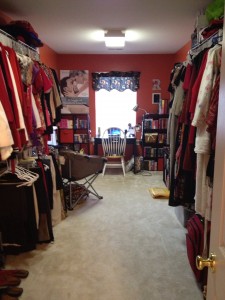
My husband, the wonderful Main Man, surprised me with a Christmas present —a brand new office space where I could focus, produce and energize myself. I am lucky enough to have a closet which is 22 feet long by 8 feet wide where I had wedged in a small space to write. The Man and I put our heads together and reorganized the space to allow half of it to serve as my office, painted it and added a desk and bookshelves.

dutchThe resultant space is cozy, inviting and MINE. (except for when The Beast comes for a visit) I can shut the door and go into my own world and focus on my craft. Now, I just needed to shift my attitude.

I will be the first to admit that I am lazy, a slacker and a procrastinator of the first order if I’m allowed to get away with it. I love TV and internet shopping and generally goofing off. The problem is that I’d get to the end of the day and face a blank page and a daily page count. I’d get it done but it was exhausting and even I (who can easily function of 5 hours of sleep per night) was hitting the limit.

So, I sat down with the sole employee of Burning Up the Sheets, LLC (that would be me) and had a stern conversation about how things were going to be in 2013. The first change was to begin getting up at 5 am and writing as many pages of my daily goal before I got the kids up and I headed off to work. I already spend every lunch period writing so I told me (quite sternly) to keep doing that with the goal to have the page count complete by mid-day.  Blog posts would be written on the weekends and social media would be done during my daily work breaks. On a good day, I would have some free time in the evenings to work on future projects, read, or spend time with the Main Man.

So, how is this working?

So far, it’s working out very well. I meet my page count everyday and usually exceed it. I have been able to juggle multiple aspects of writing and editing without burning the midnight oil and I’ve even been able to watch some TV real-time and not on the DVR. Now, I’m going to incorporate a workout schedule and I think I’ll be functioning at my optimal best.

It isn’t perfect and I still find myself hitting the snooze button on occasion but I love how good it feels to ease into my work day with my writing – my passion—given the attention it deserves.


What changes have you made in 2013 to meet your writing goals?


Happy writing!

Robin Mermaid

Mermaid avatar


Ask a Mermaid: More of Courtney Milan’s Profit and Loss Secrets Revealed

Ask a MermaidjpgNormally, Ask a Mermaid is limited to one question and a handful of answers. However, when Courtney Milan agreed to answer all of our questions about determining profit and loss, how could we say no? The conversation started after this discussion on Dear Author about the hidden costs of 99-cent books. In the comments, Courtney revealed she runs a profit and loss analysis for each of her titles.

We had to find out more and Courtney agreed to come hang out in the Waterworld Mermaid lagoon and explain it all. It was all so awesome that we had to drag her back into the pond for a second day. (You can read day one here.)

How could a writer implement this in their business plan?

Here is my shocking answer: I don’t really know. I don’t have a business plan besides: “Write books, hope people buy them.” I know that it seems contradictory in comparison with the fact that I have this huge, massive, detailed P&L procedure, but I’ve read about business plans and every time I think of doing one, it sounds boring so I don’t do it. Bah humbug. I like examining trees. I don’t care about what the forest looks like.

I have now horrified every accountant who was nodding her head about my P&L procedures.

Do you do a profit/loss projection for every title?

I do a profit/loss projection for every discrete project, not just every title. Let me explain. After I decided to self-publish, I got an introduction to a German translator, and the opportunity to have her translate my novella into German. I already had a few of my first books translated into German, and so I thought, basically…well, is this worth it?

So I ran a P&L. I estimated I would pay a little more than $2,000 for the translation and proofreading. Since I was planning to sell the book at €1.99, I’d make about 83 cents per sale—meaning I’d have to sell about 2,400 copies to make a profit on that particular project. At the time I had literally no information about the German digital market. At the time when I agreed to do this, there was almost no digital market to begin with! Amazon.de had only just opened its doors—in fact, I started talking to Ute, my translator, before Amazon.de went live. Apple’s iBook store was open in Germany, but the volume was super-tiny. I used estimations from the early US ebook market percentages to do my P&L, and I figured that I would be lucky to make my money back in two years. Worst case scenario was that I would get about $50 in income, making a loss of $1950. Best case scenario was that I would make about $2500, which was an infinitesimal profit.

So…why did I do it anyway? Because when I was looking at the income side of the column, I realized there were intangibles in the income side. Having a low-priced short would catalyze sales of my other books, which increased the chances that I would be able to sell foreign rights for my other books. I was also purchasing information—I wanted to get some idea of what the size of the market was for German language books, and this would allow me to know what sales looked like, and to get some idea of when the German language market was ready to take off.

Luckily for me, the market took off much faster than I thought—and I learned a ton about selling to new areas where I hadn’t yet broken in. One of the big things that I learned was that reviews were important to sales. My sales did a huge jump when I got my first review on Amazon.de. So when I put up my second book, I contacted a number of reviewers and sent them review copies in exchange for an honest review. That in turn meant that my second book started with an even bigger bump in sales.

It’s okay to choose to do a project that you think you’ll lose money on if you think you’re taking that profit in other coin—goodwill, information, as a trial run, because you like working with certain people and want to continue doing it…

This will freak some authors out. Should it?

Courtney_075webIf this really freaks you out and you don’t want to do it, nobody’s holding a gun to your head. My P&L statements are something that I think are of more use to me in determining when not to spend money (and thus reduce expenses), to make me think about what I’m getting from taking on a project. But as noted above, I don’t even have a business plan and don’t plan to write one because I think it sounds boring.

So. I’m not one of those people who will say, “If you don’t do it my way, you are doing it wrong!” Do it whatever way works for you.

Does this only apply to self-publishing or can traditionally published authors use this tool also?

I think that for me, the purpose of running a P&L is twofold.

1. It makes me think about the expenses I incur. Are they worth it? Really? What am I buying for my money’s worth? I had to ask myself, “If this expense is the one that meant I didn’t think it would be profitable to run the project, would I think that it was necessary?” In that sense, running a P&L is like keeping a food diary.

So, for instance, the P&L made me reconsider the expense of attending conferences. What are they getting me? What are they costing me? Does it make sense to spend $2,000 to go to MegaCon just so that 15 more people buy my book, or is there a better way to get 15 people to read my book?  That was a question that I wasn’t doing a good job of asking myself, and it really helped me clarify my thoughts and curtail spending on unnecessary things that weren’t advancing my bottom line. And that’s something that I think every author can benefit from.

2. It makes me think about the non-monetary value that I get from things. There are some projects that I’ve taken on despite the P&L. For instance, I make large-print editions of all my works available through CreateSpace. It costs me $25 to put those versions in expanded distribution, and it’s perfectly clear that I may very well not earn my money back on those. I still keep doing it, though, because I think that it’s important to keep my books accessible to readers who want to read in print but can’t read small type. I get non-monetary value out of making my books accessible. The P&L forces me to admit that I’m doing something for the nomonetary value.

Just because the P&L isn’t favorable doesn’t mean I have to say, “Well, screw it, it’s not profitable enough.”

It does focus my efforts, though. Both of these things are useful for all authors.

What else should we have asked that I didn’t?

You didn’t ask about the value of an author’s time or opportunity cost. (These things are related, of course.) But there are already so many words in this interview that I think we’ll all be happier if I just shut up now. 🙂

***

We don’t know about you, but we could sit in the lagoon with an adult beverage and chat with Courtney for another few days.

Ask a Mermaid: Courtney Milan Explains Author Profit and Loss

Ask a Mermaidjpg

Have a question for Ask a Mermaid? Shoot us a line.

Normally, Ask a Mermaid is limited to one question and a handful of answers. However, when Courtney Milan agreed to answer all of our questions about determining profit and loss, how could we say no? The conversation started after this discussion on Dear Author about the hidden costs of 99-cent books. In the comments, Courtney revealed she runs a profit and loss analysis for each of her titles.

We had to find out more and Courtney agreed to come hang out in the Waterworld Mermaid lagoon and explain it all.

In writer terms, can you explain a profit/loss analysis is and why authors should implement one?

A profit/loss analysis is exactly what it sounds like: It’s a document (officially, I use a spreadsheet) that forces you to figure out what you would have to spend to do a particular project, and that projects what the potential profits are. In order to do this, you need to be able to figure out what you will need to spend money on—this is the easy part, although there are some tricky things involved—and to project about how much you’ll make.

Where were you at in your career when you start doing profit/loss extrapolations on your titles?

I did my first profit/loss when I was considering self-publishing. I compared what my contract offered me, and considered what my potential income was from both a self-publishing and a traditional publishing contract.

But there’s no reason why I shouldn’t have done one for my publishing contracts! One of the things that doing a P&L does is it forces you to think about what the return is that you’re getting on your investment.

What did you base your formula on or did you create it from scratch?

Courtney_075webA very long time ago, I read an article on a publisher’s P&L statement from Anna Genoese (available here), who is now a freelance editor, but at the time of writing, she worked as an editor for Tor. When I read it, I was still an infant in the world of publishing, so I took it simply as an interesting note—something to think about what publishers did.

When I was thinking about becoming a publisher myself, I decided that I needed to do a P&L statement of my own.

As Anna Genoese says on the linked page, the calculation there is firmly rooted in the old print era. But you can get the basic idea of what it’s about: You need to figure out all the places you’re going to spend money, and then try to figure out how much money you’re going to make.

Can you outline how you perform a profit/loss projection?

In order to do a P&L, you make two columns: Income and Expenses.

The easy column to figure out is expenses. I say that column is easy not because it’s not time-consuming, but because it is composed of expense items that are knowable before the fact. Your job is to figure out how much you are likely to spend on the production of a title. In order to do that, you need to walk yourself through the process of what you’d do to put the title out.

If you’re traditionally publishing, you might include:

  • A prorated portion of expenses related to your computer, printer, internet connection, and office;
  • The cost of research materials and research trips related to the project;
  • A pro-rated portion of expenses for attending writing conferences during the year and dues paid to writing organizations; and
  • The cost of print mailings, e-mail newsletters, bookmarks, promotional items, contest giveaways, and other forms of advertising.

If you’re self-publishing, you might include all of the above, plus:

  • The cost of a developmental editor, a copy-editor, and proofreading;
  • The cost of a cover;
  • The cost of formatting a book;
  • The cost of a copy-writer;
  • The cost of an ISBN; and
  • The cost of copyright registration.

Some people will be able to avoid a few of the line item costs by using their own time or the time of friends as a substitute, or by skipping some items altogether. For instance, most people write their own copy, or get friends to help them with it, and many people don’t get ISBNs, and those are perfectly reasonable choices to make.

The costs of these things are discoverable. Do research. Find out what average costs are for editors and covers and formatting. Ask yourself what a reasonable amount to spend on advertising is, and make yourself justify whether it’s worth the cost. Add a buffer amount, because inevitably, especially when you’re first starting out, you will make missteps—you’ll hire a proofreader because they’re cheap, and discover that they’re not actually very good and you have to pay someone else to redo the book. (I’ve done that, yes I have.) You’ll get a cover and send it to friends and they’ll say, “You know what? That’s terrible. You can’t put that out there.” (I have done that, too, yes I have.)

This will take a little work and research on your part, but it’s work and research that only needs to be done once; after you have your stable of good people, it’s a lot less work on a going forward basis. The first time is definitely the most time-consuming.

The hard part for a self-publisher is trying to estimate income.

(This is hard for traditional-publishers, too—you don’t know if you’ll earn out your advance, if you’ll sell foreign rights, etc.—but at least you know what your advance actually is.)

To estimate income for self-publishers, we use a trick used by traditional publishing. They estimate income by looking at “comps”—that is, it tries to identify books that are comparable, and uses the sales from those books to estimate the sales potential of your books.

So in order to project your income, you need to figure out who you are comparable to, and that is not easy. This is what you need to do. You need to identify authors who are already publishing who are (a) at your approximate stage of your career, (b) write in the same subgenre, and (c) have the same reach as you in terms of social media and fanbase. You need to estimate what their sales are.

Pause for a second. You may be wondering how you can estimate another author’s sales. There are three methods that I can think of.

1. Find people who share sales numbers—there’s a lot of them in self-publishing! Look for people in your subgenre who are most like you.

2. Identify people who are like you and ask them directly if they’re willing to share sales numbers. Many of them are. If it’s someone who is a friend of yours, they may be more willing to share. If they’re someone who seems upfront about things, they’re probably willing to share. If it’s someone you don’t know who has never posted about their numbers? Enh. It can be considered kind of rude to ask about numbers, so don’t go around badgering people willy-nilly

3. Take a look at books written by people who are like you, look at their Amazon rank, and use Theresa Ragan’s handy-dandy sales ranking chart to try and estimate how many copies they’re selling a day, and from there, make a reasoned guess as to how many copies they will sell within a year.

There is substantially more variation in sales, though, for a digital self-published project as compared to a print one from a major publisher. For a print project, most publishers have a pretty good idea how many copies of a title they can get an account to take, with some variation allowed, and once a book is on a shelf, they have some good statistics as to how many of those books get returned.

For a digital project, it’s much harder. Some books take off right away. Some languish and never move. And there are numerous intermediate options.

When I was doing my estimates, I came up with a best guess scenario, a worst case scenario, and a holy crap, that would be awesome scenario.

Can you share an example of using your formula for one of your books?
51KqDUqK1jL._BO2,204,203,200_PIsitb-sticker-arrow-click,TopRight,35,-76_AA278_PIkin4,BottomRight,-64,22_AA300_SH20_OU01_Absolutely. The first calculation I did was the calculation for Unraveled, which was the book I could have either sold to Harlequin or produced on my own.

The expense part was pretty simple—just the application of time and elbow grease.

To find comps, though, was a little more difficult. I had one advantage, and that was that I had an example of a book and an author that was pretty similar to mine—that would be my own books. At the time I was making the decision, Unveiled had just released from Harlequin. Even though the price point was different, the Amazon rank + a sales ranking chart from the time allowed me to estimate about how many copies it was selling. I estimated that it would sell about 10,000 digital copies in the first year of its release, which at a price point of $3.99 would make me about $26,000 in income. That was my best guess scenario for Unraveled.

My worst case scenario was that it would sell about 3,000 copies in a year, for an income of $8,379. I don’t really want to identify what I used as a comp for that because pointing to another author’s book and saying, “This is the worst case” is really not a nice thing to do.

For my best case scenario, I used a comp from Gwen Hayes, whose short story Second Son of a Duke had been eating up the charts. She told me how many copies she’d sold in a few months, and what the tail-off effect was over time. I extrapolated from that that my best-case scenario would be that I sold around 20,000 copies in a year, for a total of $51,850 in income.

In my case, I was running tandem P&L reports, because I also had a contract offer from Harlequin on the table. They offered me $35,000 for the next book, and I was fairly certain that it would take me a very long time to earn out that amount, so that meant I would be getting $29,750 (after my agent’s cut). I’d also have fewer expenses.

So if I only looked at the first year of my P&L, I would have said to go with Harlequin’s offer. But year  two was where I thought I would get ahead: I projected about half the sales from year 1 in year 2, making the worst case scenario $12,568, the best guess scenario $39,000, and the best case scenario $77,775.

Doing the P&L this way forced me to accept that I was taking a risk—that there was a real chance that I would lose money by turning down Harlequin’s offer—but that the upside potential for the book was much, much larger by choosing to self-publish.

Note that there are two things that factor into this calculation:

1. How risk averse you are, and

2. What you think the time-value of money is.

If, for instance, I had needed the income from my writing to live on, I’m not sure I would have turned down Harlequin’s offer. It is hard to turn down money you need to pay the rent today with the possibility that you might end up on the streets glaring you in the face. Second, it’s always possible that I could make money into years three, four, five, and six—in fact, even from year sixty—from both my traditional and self-publishing contracts. The truth is, though, that making $10,000 sixty years from now is not the same as making $10,000 now. I have to figure out how much I value having money sooner. What I end up doing to approximate the time-value of money is to make some reasonably positive assumptions about years one and two for all cases, and to neglect the income from years three to infinity. Since I’m doing this for decision-making reasons alone, I don’t feel badly about that. If I were presenting this information to a bank or a decision-making body, I’d have to do a better job at estimation, but I don’t.

As a note: At this point, I don’t use any comps but my own books, and I tend to be very conservative about the performance of my own books.

It turns out that with the exception of two projects, I have consistently exceeded even my best-case scenarios. My estimates are probably too conservative. I don’t plan to adjust my calculations, though—it’s good for me to remember that even though things are going well now, there are no guarantees for the future.

***

Curious about how you can implement Courtney’s profit and loss system yourself? You’re in luck! Courtney is diving back into the Waterworld Mermaid lagoon tomorrow to explain how you can do that and more.


I Heart Sherrilyn Kenyon & Super Fabulous Dark-Hunter Giveaway!

Happy Friday Fishy Friends!  I’m completely excited about today’s post because I’m giving away one very special Sherrilyn Kenyon Dark-Hunter novels collection set.  *Giveaway info at the end of this post*Mermaid Carlene

But first I’d like to share a fun story with you.  So, I firmly believe that if you love something, you should love it well.  Just always remember that love is respectful.

So, a few years ago, I was still relatively new to the DC area, settling into my home and continuing to quietly work on writing.  I was so new to it back then that I had no idea about writers groups, contests, or conferences.  But I was VERY familiar with Sherrilyn Kenyon’s books and had become a huge fan since being given “Seize the Night” at the 2008 San Diego Comic Con.   During a regular check of her upcoming appearances in my area, I saw that she was going to be doing a signing in some place called Leesburg, VA.  I could tell by the event details that this wasn’t just a regular bookstore signing because it talked about a retreat and organization that went by the initials WRW.  Well, I was a little skeptical, so I did some research. I fully intended on figuring out how to get to this signing.

That’s when my silly little brain started doing all this crazy-fantastic spinning.  I discovered several things in rapid succession:

1) WRW stood for Washington Romance Writers and they were a local writing chapter falling under the main organization which was RWA.  WRW was indeed hosting a local retreat in the spring where Sherrilyn Kenyon would be the keynote speaker and there would be a signing for the public in the area around the same time.  They also had a writing contest called the Marlene and the winner would be announced at this retreat where Sherrilyn would be in attendance as a special guest.

2) RWA stood for Romance Writers of America.  They had a wonderful website that taught me all about their Golden Heart writing contest and an annual national conference.  And, Sherrilyn Kenyon just so happened to be slated as their Keynote Speaker that year as well!

3) I had to see Sherrilyn Kenyon.  (Being around her is like chicken soup for the soul and I want lots of that.)

Sherrilyn and Carlene

BOOM, BAM, POW (that’s my brain on Sherrilyn Kenyon)

4) I could join these organizations, both RWA and WRW, submit my little (actually quite huge) love story manuscript I’d been working on to both groups.  I could win the contests, be presented my awards and Sherrilyn Kenyon would be in the room watching my acceptance speeches where I would profess my love for her and then everyone would live happily ever after.  And we might even have slumber parties and talk endlessly about Valerius Magnus and Acheron.

Fishy Kisses

Slightly crazy, I know.  But fun, right?  Long story short, I joined both organizations, entered both contests, didn’t win the awards but came away with a few hearts of gold who give great fishy kisses and had the time of my life listening to Sherrilyn speak.  At the WRW retreat, on May 1, 2011, I won the basket Sherrilyn had donated to the raffle! Inside that basket was the wrapped, five-book set that I’m giving away today.  I’ve never opened it.  It has sat beautifully amongst my Sherrilyn book collection.  I own each of the books individually and have read them several times each.

Sherrilyn Prize

I hope that whoever wins these treasures will read them and fall in love even harder than I did.

I would not be the reader I am nor the writer I’m becoming if it weren’t for Sherrilyn Kenyon.

Thank you—Xoxoxoxo

So friends, I’d be oh so happy to hear your stories of fervent love & admiration…pretty please?


*Giveaway details: This giveaway is open until 10:30pm Eastern Time on Sunday, January 27, 2013.  At that time, I will randomly choose one winner from the commenters to this post and announce the winning name in the comments section.  Please be prepared to share your snail mail address with me so I can send this one of a kind gift your way! *

Five book set includes: Night Embrace, Night Pleasures, Night Play, Kiss of the Night, & Dance with the Devil.