Standing Out in the Crowd

Back in March of this year, I read Author Kelly L. Stone’s post featuring Dianna Love , who is wonderful about helping her fellow writers, and she posed the question:

What makes your writing stand out?

It’s something you need to think about and as I sat there trying to come up with an answer, I realized that while in my heart I know my story is special (and so is yours, trust me), it was far more difficult to put that into words.  Imagine that, a writer at a loss for words!  The interesting thing was that Dianna had posted a question to her fans on her Facebook page in preparation for the blog post asking what they thought made a story different.  Being a huge fan of her work, I threw out my two cents and she used it in the post.  Why was it so easy for me to say, “One of the things that makes a story stand out for me is what characters say to each other” to Dianna in reference to what I think makes hers and other authors’ books I love stand out, but then sit in my chair and feel so blank when it came to my own writing?

I think it’s because when I hear that question, I immediately assume the answer should revolve around the plot.  Well, for me, it’s not likely going to be my external plot, but rather my characters and what they say to and do with each other.  It’s why the story about a rock group I read last year was probably pretty basic but I still remember verbatim a line from a trip the band took to the grocery store with the heroine.  Here’s to hoping my future readers appreciate that part of a story as much as I do because it’s what I’m going to be sharing with them.  The things we say to each other.

Readers-what do you remember about a story, even a year after you’ve read it?

Writers-what do you love about your stories? psst-this is what makes them stand out 😉

What I Love About Writing Romance

So a while back, I had a post on my blog about how there are days when being a romance writer sucks big hairy ones. I won’t say what those ones are, because this is the Waterworld Mermaids and the lagoon isn’t like that. 🙂

And it’s true some days the keyboard kicks me in the shins. However, there is so much to love about being a romance writer and I wanted to share 10 of my favorites. Add yours in the comments section and we’ll blow the Internet apart with our love. Hey, it could happen.

10. Hot men who take off their shirts whenever I want them too. Someone should do a study about the motivational properties of washboard abs.


9. Tough chicks who don't back down. They may get weary. They may get knocked around a bit. But these women always get back up and fight the good fight.


8. Exotic locales. OK, I know my books are set in Nebraska, but that has to be exotic to someone who lives in Tahiti, right?


7. Witty banter. Who wants main characters who only stare lovingly at each other? Not me. Give me verbal fireworks. (Apples and oranges - opposites attract. I crack myself up. )


6. Giggles. Enough with the doom and gloom. If Wesley had time to crack jokes while saving Princess Buttercup so can my heroes.


5. Hot, mind blowing sex every time. Yes, every time. With multiple orgasms. And no one is injured by a wayward elbow even during the most gymnastic of interludes.


4. The chase. Let the anticipation build and build until they either have to catch each other or the book will spontaneously combust with anticipation overload.


3. The lightbulb moment. You know what I'm talking about, that single moment of realization when the hero and heroine finally figure out that this isn't just lust - it's something much more. This always gives me butterflies.


2. Sacrifice. Just wanting to be together isn't enough for me. I want my characters to fight for it, slay dragons to be together and overcome the evilest of villains.


1. Happily ever after. Need I say more? I think not.


OK, you’re turn. What are your favorite things about writing romance?

Research: Not Just Another Dirty Word

The Waterworld Mermaids are very excited to have fellow WRW member and super awesome chick, Kimberly Kincaid, guest blogging today. Besides owning some of the coolest clothes around and leading us in an amazing yoga session during WRW Retreat, Kimberly writes contemporary romance novels that split the difference between sexy and sweet. She is a 2012 Marlene winner, and a 2011 Golden Heart and Golden Pen finalist. Kimberly is proud to be represented by Maureen Walters at the Curtis Brown Literary Agency.

Take it away, Kimberly… 

Today's Guest Blogger, Kimberly Kincaid


Research: Not Just Another Dirty Word

Okay, okay. I’ll admit it. I was a bit of an aberration in high school. Was it my gravity-defying hair or my odd penchant for John Hughes movies? No, love affairs with Aqua Net and Jake Ryan were strangely the norm back in my teen-angst days. But I was definitely the exception to the rule when being given huge school projects, because while my peers were moaning and groaning about all the hard work, I was doing an inner touchdown dance of joy.

My confession is this: I love research.

Now, I’m the first person to admit that research can be pretty grueling stuff. Yes, it’s cool to gather and discover new information, but being up to your elbows in reference manuals or looking at a daunting 246,000 hits on a Google search can be pretty overwhelming stuff. So what’s the best way to make this part of the writing process not just easier, but fun?

Funny you should ask.

Plan, and then plan again. When we’re just starting out with our manuscripts, laying the research foundation is crucial. After all, what we turn up will likely impact our plot and characters, so having a good game plan is key. Outline your characters’ occupations and situations. Will your hero be a business owner? Your heroine a paramedic? Has one of your characters lost a spouse? Narrow these things down as you plan, and let them guide you into solidifying that first layer of your manuscript.

Play online. Repeat after me: Google is your friend. Let’s go with that hero who’s a business owner. Plugging “business owner” into an Internet search engine is likely to give you enough hits to break the six digit mark by a landslide. But if you play around with your keywords (“small business owner, Philadelphia” or “family owned furniture shops”, for example) will knock your numbers into the manageable level. Yes, you’ll still have to weed through the results, but the payoff will help cement that foundation into place.

Ask around. Research can—and does—happen in the most unlikely places sometimes. Your baby-sitter, your spouse’s co-worker, the guy detailing your car, all of these people are potential treasure troves of research. Don’t be afraid to casually mention that you’re writing a book about a small business owner. Chances are, you’ll be pleasantly surprised at who comes out of the woodwork with a friend/cousin/neighbor/great aunt Bessie who runs her own business. Case in point: I was ankle-deep in my first foodie manuscript when a friend of mine mentioned she knew a local restaurant owner. Which brings me to my next point…

Go where the pros are. If you want to write a realistic small business owner, things will be leaps and bounds easier if you can meet up with one to bounce questions off him or her. I like to go with a few open-ended questions like, “What does your average day look like?” and “Tell me about the biggest challenges you face in your profession”. Seeing your pro at work can also be incredibly beneficial. Remember that paramedic heroine? If you want her to be realistic, ask your local volunteer rescue squad if you can do a couple of ride-alongs. Seeing them in action will give you a sense of some of the things your character should be doing. After I sat in the kitchen of that local restaurant owner I met through my friend, I was able to create a colorful and realistic backdrop for my story, as well as enrich my chef characters with attributes that never would’ve occurred to me if I hadn’t seen the real pros in action.

First-person is sometimes best. For those of you writing about serial killers, skip over this one! For everyone else, consider putting yourself in your characters’ shoes. Does your hero have a rock-climbing hobby? Find a company that offers lessons for beginners. Is your heroine an artist? Pick up some brushes and paints at your local art supply store and play at home. You don’t have to be good at it, but if you’re able to accurately describe the burn of your muscles as you try to pull yourself higher or the smell of the oil paints when they’re fresh out of the tube, you’ll create scenes that will put your readers in your book right next to your hero and heroine as they do those things too.

So you tell me readers! What are some of the most fun things you’ve done for research? What are the things you dread? Do you go for the paper research, or are you an experience junkie? Tell us your most tried-and-true methods!

In the middle of "research"


Thank you for swimming in the lagoon with us today, Kimberly!

When she’s not sitting cross-legged in an ancient desk chair known as “The Pleather Bomber”, Kimberly can be found practicing obscene amounts of yoga, whipping up anything from enchiladas to eclairs in her kitchen, or curled up with her nose in a book. She resides in northern Virginia with her wildly patient husband and their three daughters.

Me and BEA

June 5 and 6 – Jacob Javits Center, NY

Spoiler alert: Throwing yourself into the Book Expo America trade show is a lot like throwing yourself into a mosh pit.  Maybe you’ll come out better for the experience.  Hope!  Hope hard!

Understand first that Jacob Javitz, in Manhattan, is a mammoth exhibition hall.  It’s not meant for the faint of heart.  But I’d brought my bar-code admission ticket, the lines were manageable after rush hour, and I received my ID and lanyard in record time. 

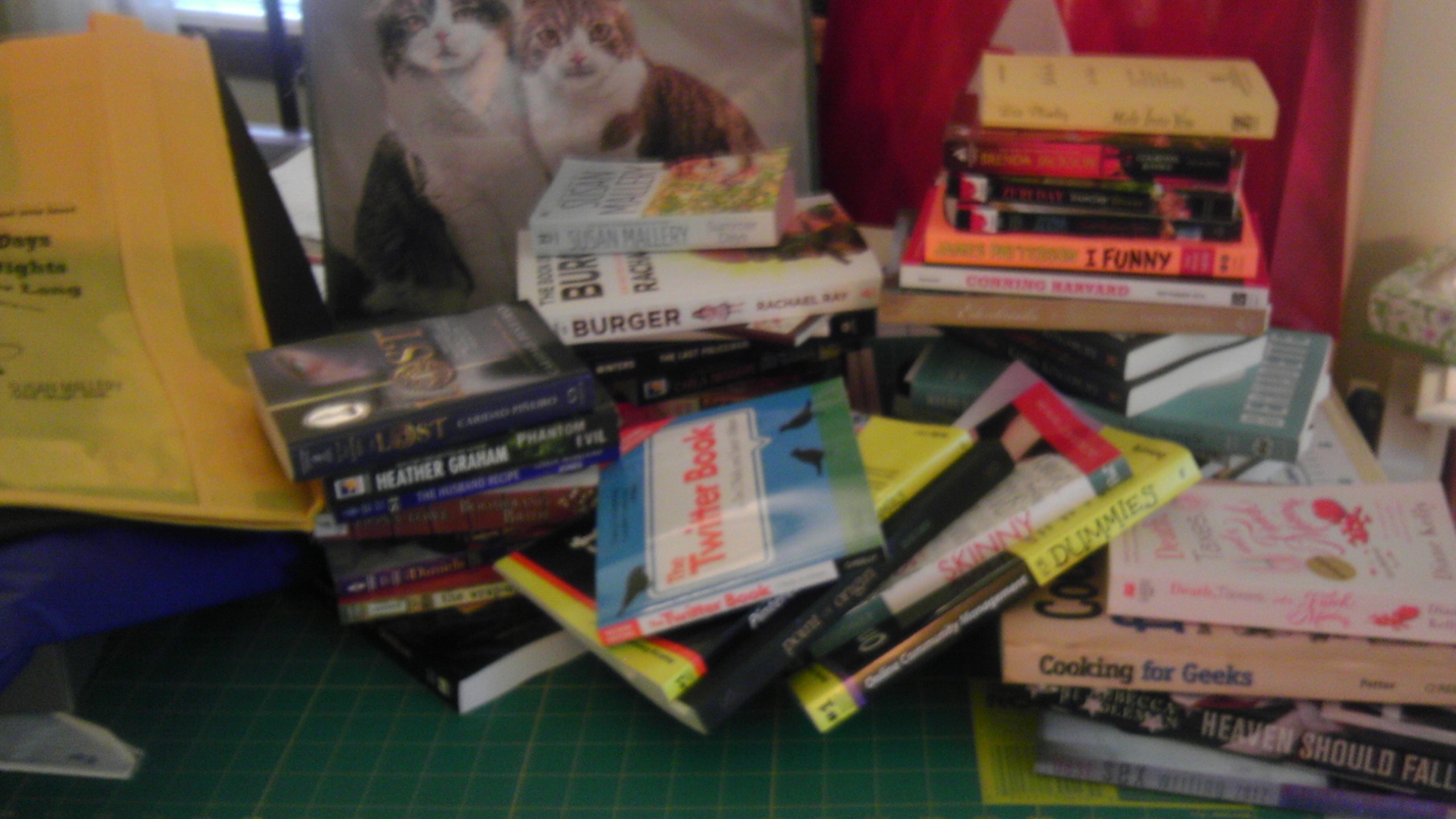
I didn’t attend the entire four day conference. I didn’t get to see any of the special events, or break-out sessions or panel discussions. I just trolled aisle after aisle of publisher displays, marveled at the number of books being promoted, signed, or simply piled up for the taking.  Stood in line at Harlequin, Wiley, Penguin, Simon & Schuster, RWA and smaller publishers like the lovely Shadow Mountain Publishing booth and Ellora’s Cave.  I got bling: a vampire first-aid kit for EC, a whoopee cushion for James Patterson’s new middle-school series, and more tote bags than I need (but who’s complaining?).  Oh, and also the Ellora’s Cave 2012 calendar, autographed by the ManWars-worthy studs, uhm, models (like, are those biceps real? Really?).  After the intense experience that is BEA, I would say: 1) the publishing industry is alive and well, 2) publishers are adjusting as quickly as they can to the digital content revolution,  3) it’s still all about the fun of reading, and 4) don’t sit on a chair in a publisher’s booth without getting permission (practice your “pity-me” smile).

One of the best experiences was my chat with Robert Barrett, co-founder of Autography (http://www.autography.com/).  This platform allows an author to digitally sign an e-book.  Whether at an in-person event or remotely, the author can personalize their e-book for the reader.  He showed up later on at a book signing, offering a the book as a digital download free, with a photo of the author as well as her autograph.  Autography can also work as a publisher platform (but really, take a look at the website, it’s very “next hot app” stuff).

More fun were the enhanced barcodes (which I haven’t figured out yet) on books like The Book of Burger by Rachel Ray.  They promise enhanced digital content.  One of the YA books being promoted offered geographical and historical backstory to the main content.  If I could remember the title, I’d point you to it (are you getting now just how busy those two days were?).  Also, the bling!  Don’t forget the bling.

What’s not fun?  Standing in line for a hot title or celebrity author and finding they’re signing postcards.  Or excerpts.  Honest.   More than once, I saw more the line melt when the signing started and word got passed down.  Sweetheart, there are better books available than what you’re offering right now.  Yes, I know there are possible explanations, but it stings.  It really does.

Using two days out of four, one day was given to writer-centric pursuits, and the other to reading, reading and more reading.  Which is why going a second day, and with a friend, changes a person from a well-behaved professional into a raving lunatic fan: 

I’ll be posting book reviews of my faves in a later post.

If you have the chance to go to BEA, make sure your shoes are sturdy, cards are in your back pocket, your phone is set on stun and your wallet crammed with cash.  Next year, I want a third day, to explore the advances in digital publishing.  Especially since almost everything that was seen this year will be “old” in twelve months.


Book Review: Break Into Fiction

Two years ago, at the WRW Annual Retreat which was held in Leesburg, VA, I had the great fortune to win a raffle basket donated by Dianna Love.  Inside were all sorts of cool treasures but the greatest of all, as I discovered last month, was a copy of her book with Mary Buckham, “Break Into Fiction”. 


I highly recommend this book if:

You are a beginning writer.

You are an experienced writer.

You are beginning a new story.

You are like me and editing/revising a completed draft.


The book is so very friendly.  It shows you how to easily recognize the key elements of successful commercial fiction in several popular movies (by walking you through templates for each of the movies) so that you can then use those same templates to develop your own story idea.

There are two aspects I like best about Break Into Fiction.  The first is that this book is multi-genre.  The movies associated with the templates range from Suspense to Romantic Comedy and from Classic Romance to a modern Disney favorite.  I appreciated this because I write out of the box and I appreciate an approach that is about successful commercial fiction.  Period.

The other thing I loved about Dianna and Mary’s approach is that its focus is on your characters.  Don’t get me wrong, right smack dab on the cover of Break Into Fiction, it says “Power Plot Your Book”.  I won’t lie, when I saw that, my doubts crept in as to whether this was the book for me.  My strength is the internal emotional journey of the character, and so naturally, plotting books generally intimidate me.  However, that’s where Break Into Fiction is truly a blessing.  What you will learn as you go through the power plotting templates, is that everything blossoms from your characters.  There is no separation between your protagonists and the elements that will drive your plot.  Until I read and used Break Into Fiction, I always saw those as separate entities and therefore my stories felt disjointed between my strong characters and not so hot plot.  This book has helped me fix that!

And, Break Into Fiction isn’t just a book.  It’s an interactive system that includes a wonderful website with information on the authors, seminars, plotting retreats and professional editing services, among other things.

Did I mention that #1 New York Times best-selling author Sherrilyn Kenyon put her stamp of approval on Break Into Fiction by contributing the foreword?  Seriously, this is a book all writers need.  For more information, check out www.breakintofiction.com

Lessons from the Playground

Recently, when I went to pick up my children from school, my five-year-old daughter burst out of the classroom, leaped into my arms, and buried her face in my neck. When I asked her what was wrong, she said her best friend had told her, “I don’t like you anymore.”

Wow. It’s hard enough to hear this kind of sentiment as an adult. But for a sensitive five-year-old who has never experienced rejection? Devastating.

I’m happy to say it all blew over. After a little investigation and instruction from the moms, apologies were said, the girls hugged, and now they’re friends again.

Afterwards, my daughter and I came home and had a long talk. About friendships and strategies and coping mechanisms. And what struck me the most about this conversation was how wise I sounded. How, coming from an adult perspective, I could so clearly see the “right” solution to my child’s problems.

At the same time, I recognized I was being something of a hypocrite. Because, you see, the lessons I was trying to teach my daughter are the very ones with which I’ve been struggling.

Here are some of the things my daughter and I discussed:

1. You shouldn’t want to play with someone who doesn’t want to play with you.

So simple, right? So true. But if that’s the case, then why does rejection hurt so much? Whether it’s by an agent or an editor, a loved interest or a friend, rejection sucks. Big time. But it shouldn’t. Instead, we should just see the pass as information gained and move on with our lives.

For example, writers look for a literary agent in order to find an effective advocate for their work. If an agent does not love your work, then he/she, by definition, will not be an effective advocate. So you shouldn’t want to work with an agent who doesn’t want to work with you. Right? So simple. So true. And so much easier said than done.

2. If someone is mean to you, walk away.

It is so easy to get caught up in other people’s drama. To get drawn into an argument, to retaliate to their hurtful behavior. When the truth is, it is so much simpler to step away and focus on your own work, your own interests, your own family. I may have given this advice to my daughter as if it were truth, but it is something which I constantly have to remind myself.

3. If you want to have a friend, then you have to act like a friend.

I think we all learned this friendship adage a long time ago. I know I did. And yet, I am still learning the corollary: If you want to be a writer, then you have to act like a writer. That means, working on my manuscript, whether or not the muse strikes. It means being willing to do the hard stuff, the parts I may not particularly enjoy but that need to get done. It means getting up to write another day, no matter what blows have been dealt the day before.

4. Just because your friend wants to play with somebody else doesn’t mean she likes you any less.

This, perhaps, was the hardest truth for my daughter to swallow. In her mind, preference for another friend automatically equals rejection of her. As adults, we know better. Or do we? If the writing corollary were true (someone else’s success has no bearing on our own), then why, in the midst of our sincere excitement, do we feel that tiny twinge of, well, rejection when we hear another person’s good news? I honestly don’t know.

Maybe it’s human nature. Maybe it’s because our hearts and heads don’t always align. Or maybe these lessons from the playground are just ones that we continue to learn, every single day.

What do you think? What lessons do you continue to learn as an adult? Why is it so hard for our heart to follow what our minds know to be “true”? What is harder– dealing with friendship drama as a child, or having your dreams rejected as an adult?

The “Ouch” Factor

Since I seem to be stymied in a flagrant writer’s block, AND I’ve been pondering the topic of rejection, I figured I’d recycle something I wrote in my blog when I was unemployed.   I found the two conundrums to be somewhat related.  Although with writing, there is always the chance to improve.
 
I am becoming very familiar with something I have dubbed as the ouch factor.    You saw the perfect job.  It was as if the stalked your resume, wrote the job for you and did everything short of contacting you for the position. You apply, get a call back, go for the interview and receive almost instantaneous positive feedback. Then a week goes by and you get “the call.” You were wonderful, amazing, the best thing since sliced bread, but unfortunately they found someone who had a plethora more experience. In the meantime, they will keep you in mind for anything that comes up in the future, because you really and truly were the cat’s meow. Feeling very satisfied with yourself, you ride the wave of sugary optimism, until IT happens. A week after your glowing let-me-down phone call, you see it: your job is back on the advertisement roller coaster.  And then you realize you got the “it’s not you, it’s us” routine in over the top fashion.

That first moment when you see that ad is the ouch factor. Within a span of ten seconds, you go through a myriad of emotions. First, you can’t believe it. You check the company and the language in the ad.  Yup, exactly the same.  Word for work.  Then confusion sets in.  Maybe there was some sort of mistake, mishap with the publishers, a cruel prank?  When those options don’t pan out, anger swoops in.  How could they pass up on someone like you (remember, they REALLY built you up).  You were amazing, wonderful, fabulous.   And then, comes the inevitable crash. It’s the realization that not only did you not get job, they didn’t think you were the greatest thing since sliced bread, but they were willing to start the process all over again because you were that bad of a candidate. It’s truly amazing, but all those emotions course through your body in one giant ball that can only be classified as a big “ouch!”

The ouch factor is really just the knee jerk reaction to rejection. Nothing more, nothing less. The only good thing with the ouch factor is that, like a bandage being ripped off a hairy arm, it comes in the form of a pointy arrow that shoots and then leaves.  So in the end, maybe it’s better that the rejection came with such a swift force. At least it’s better knowing.

Monday Morning Push…Up.

This morning was a difficult morning…and yet, I feel I have a sense of need to ‘get things done’, despite the hectic morning.

Does this make sense to anyone?

Getting hubby ready for trip, daughter off to her last week in school, laundry finished, bedding washed and still managed my two mile power walk–I’m now ready to focus on the day ahead (as if I wasn’t all ready).

So this Monday morning is my push UP… for the week ahead, my yellow legal pad of items to tick off in between writing this week.

A recent need to revise a manuscript has me anxious to complete the B.I.C.H.O.K (Butt In Chair Hands On Keyboard)program I had started last week. But I also want to take time to enjoy the beautiful day. I want to balance my accounts/pay my bills and still have money in the bank (ROFL–yeah, as if!)  I want to clean out my closet/my purse/ my car and two pantries and still have time to enjoy a movie night with my daughters.

I have goals I need/want to set for not only my work but my family life and health.  I want to approach each morning as a Push…Up.  There is nothing that can push me down.

Looking forward to adopt this ideal… Raising my cup of Vanilla Bean Latte to Monday Morning Push Ups!  May what we write down today for goals be done either by tonight or the end of the week.

So get your Push Up for the week  in!  What items are on your yellow legal pad to do this week?


Mermaid for a Day – Willa Blair

In April of 2011, thirteen Mermaids met at the annual WRW Retreat and soon afterward formed the Waterworld Mermaids. One year later, those same crazy Mermaids gave a panel at the 2012 WRW Retreat on group blogging and declared one person Mermaid for a Day. It’s safe to say that we are all thrilled to introduce you to Willa Blair, Mermaid for a Day, soon-to-be published author of Highland Healer and all-around amazing person. Take it away, Willa…

First, I’d like to thank the Waterworld Mermaids for having me here today. Being an honorary Mermaid is so much fun. I love what you’ve done with the Mermaid Pool and I’m happy to be able to add my own little touches.

My debut book, HIGHLAND HEALER, is coming soon from The Wild Rose Press.

I moved from Maryland to Texas early last summer. I know, I know, it was hot. And I had to leave behind the best critique group in the world, run by Ruth Glick/Rebecca York. Though we’ve arranged it so I can Skype in when they meet (so they haven’t gotten rid of me yet) I wanted to have the same experience with writers here in Texas.

My local RWA chapter, the San Antonio Romance Authors group, was doing online critique twice a month. It’s a terrific vehicle and I highly recommend it, but I missed the face-to-face experience, so I volunteered to host a session at my house. In addition to meeting in-person, I wanted us to do what the Maryland group does — read aloud.

Ruth warned me that not everyone can do that – it’s uncomfortable at first for the reader, and not everyone is an “auditory learner” who can hear and make note of things they want to comment on. But reading aloud is the best way I’ve found to discover mistakes in your own writing. And it develops a useful listening skill – I can feel my brain stretching every time I sit in on one of these sessions. I have to pay attention to what is being said and that allows me to catch the flow and rhythm of the story, not just the mechanics of the punctuation, grammar and so forth.

The real benefit, though, is in the discussions, sometimes passionate, that these sessions provoke. The topic may be something within the story or the history or culture related to it, but inevitably that leads to the craft of writing or something about the writing business. We’ve celebrated each others’ successes, comforted each other through our disappointments, and taught each other a lot about writing. Even the most experienced, multi-published authors among us learn as well as teach. Oh, and yes, sometimes we just talk about men. We do like to talk about men, don’t we?

Here are some tips for establishing and running critique groups that I’ve learned at the feet of my mentors:

State a goal: The purpose of the group is to improve its members’ writing and help them get published. Always. No exception.

Establish ground rules to establish trust: The way to establish trust is to mandate that criticism is being given for the goal purpose and is always and utterly well-intended. That means that you have to be honest in telling someone what you think needs improvement, but you have to be able to do it in a way that protects their confidence in their abilities. You don’t necessarily go into the finer points of technique with a brand new writer; you comment in ways that they can use and learn and grow. And you can’t like everything. It’s not helpful. I belonged to a critique group early on in my writing career where everybody loved everything. And frankly, no one learned anything. That group was a good example of how not to do it.

Establish a process: Each person doesn’t read each time, but each person offers comments and critique. If someone is up against a deadline, they jump to the head of the line. If someone hasn’t read for a long time but has been an active participant, they jump to the head of the line when they have something to read. Otherwise, it’s up to the group – if there’s time for everyone to read, great. If not, some people volunteer to wait for the next meeting.

Try out different methods: In our SARA group, we’ve had people read their own writing and we’ve had each person read someone else’s writing. Some people need to see the words on paper and bring multiple copies of what will be read so that each person can mark up their pages. Personally, I prefer to read my own writing, but others are more comfortable taking notes if someone else reads their selection.

Be sensitive to each others’ moods: There are times when you can accept and even relish strong critiques, dissension of opinion over what you’ve written, even suggestions that mean you’ll have to tear your story apart and rework it. Remember that those comments are made to help you improve. But sometimes, for whatever reason, comments hit too close to home and the group needs to moderate its enthusiasm for helping you. Because of my years of experience in Ruth’s critique group, I’ve become much better at accepting criticism, and I’m a Leo — we don’t typically do that well. I’ve learned to use the critique – or to reject it if it doesn’t suit my purposes. It’s taken time to grow that extra layer of skin and to accept well-intentioned assistance, but it’s been worth it.

I know authors who say they can’t imagine being part of a critique group. They write too fast, or they get confused by the variety of opinions their work engenders, or they just want to go it on their own. That’s fine, but for me, a good critique group is a necessity of my writing life.

Thanks again, Mermaids. It’s been fun! I’ll see you around the Pool.  

Willa Blair won the 2011 WRW Marlene contest in the Paranormal category for Warrior (now Highland Healer) and she was also the 2012 Merritt Winner in the Paranormal category for Empath

Highland Healer is being released soon from The Wild Rose Press. You can find out more about Willa at her website, Facebook or follow her on Twitter – @willablair
 (we do!).

Graduation, Friends, Titanic & Change

It’s graduation season, a time I remember very well. Boring speeches, fun parties, talk of the past, hopes for the future, and friends. I still get choked up thinking about my high school graduation. I grew up in a teeny, tiny town where the people I graduated with were also in my nursery school class. I truly knew nothing but those people and that world.

So that final summer was interesting. On the one hand, you’re so excited to leave. Off to college, life is going to begin, it’s exciting. But there’s that part of you that isn’t quite one hundred percent positive that this is going to turn out okay. I’d go to a party and have fun thinking about how it was going to be one of our last night’s together but I’d also get sad thinking how it might be one of our last night’s together. Continue reading