All posts by Pintip

Can Plotters Be Made, Not Born?

pintipAre you a plotter or a pantser?

If you’re a writer, you’ve probably heard this question at some point. It’s a matter of writing method and preference. The question may even get at the way you think or perceive the world. But at its heart is the assumption that there is an answer. You’re either one. Or the other. Or a little of both.

So my question to you is: can you shift from one to the other? Or do you think there’s something intrinsic to a person that makes you lean a certain way?

Continue reading

How To Do a Writing Retreat

We mermaids have had some pretty fun writing retreats in our time. We’ve stayed extra days after the WRW retreat in Westminster, MD. We also got derailed by Hurricane Sandy at a beach house in Ocean City. Each retreat (while it lasted) yielded writing time that was focused, productive. And uninterrupted.pintip

The other day, I was thinking I could use a writing retreat right about now. I’m closing in on “The End” on my WIP, and all I need is a little push to get there. Sadly, there wasn’t one that was magically on the schedule. So I thought: why not have one of my very own?

Here’s how I’m doing it:

1. Clear my schedule. I talked to the important people in my life. Figured out which responsibilities I could get out of with a little juggling. The non-negotiable items I marked in my calendar. The rest of the time I’m reserving for writing.

2. Find a place to go. You don’t have to go out of town to do a writing retreat. In fact, I’m not, on account of my non-negotiable responsibilities. But while I will be sleeping in my own bed at night, I think a change of scenery is definitely important for my mind-set. I decided to go to my local library, from opening to closing.

3. Make a commitment to say “no.” Something will come up during the retreat time. It always does. But whatever it is, I’m going to say “no.” I’ve already determined which things are non-negotiable. Everything else can wait until after the retreat.

4. Prepare. I am packing plenty of snacks, water, warm clothes, charger, notes, iPhone, chapstick. Everything I could possibly need to be comfortable. I’m also going to get plenty of sleep at night, so that there’s no physical excuse (hungry, cold, tired) to stop me from getting the words on the page.

And that’s it! I did a test run of my “writing retreat” yesterday, with fantastic results. The official retreat is this week. Wish me luck!

What about you? Have you ever been to a writing retreat, or created one of your very own? Where did you go, and how much did you get accomplished?

Oh, and if I’m not responding to blog comments? You know where I am and what I’m doing. 🙂

Twenty Minutes

I participated in the Ruby Slippered Sisterhood’s Winter Writing Festival this year, and it was great fun. I loved the support, the encouragement, and the motivation. But the best part? The chat roompintip sprints.

Here’s how it worked: you showed up at the chat room at a designated time, where a Ruby sister was moderating. After a few minutes of chatting, the moderator announced the beginning of a sprint (usually twenty or twenty-five minutes). Everyone worked furiously. At the end of the sprint, the moderator called time. More chatting. Rinse and repeat.

It was amazing how much work I could accomplish when I knew other people were doing the same thing. Moreover, writing can feel like a lonely, solitary endeavor… but the Ruby chat room sprints made me feel like the other writers and I were part of the same team. Like we were doing something together.

Sadly, the WWF is over now, but it’s taught me a very important writing tool that I can use the rest of the year: the twenty-minute sprint.

This tool is especially useful when I’m battling writer’s block. I set my timer and give myself a pep talk. It’s just twenty minutes. Twenty minutes is nothing. You can do almost anything for twenty minutes. Just write for twenty minutes, and then you can take a break/check your email/make some tea. Go!

It works every time. (Well, almost every time.) Although that first session may not be particularly productive, I usually feel more amenable to another session when the alarm beeps. And then another. And another.

Before I know it, I’ve made considerable progress on the scene, which makes me even more motivated to continue.

For me, writing can be a vicious or a rewarding cycle. The more I write, the more I want to write. The more time that has passed since I’ve written, the harder it is to get started. The key, then, is simply starting. The twenty-minute sprint helps me get past that hump. It forces me to write that first word or first sentence or first paragraph.

So thank you, Rubies, for teaching me this valuable trick!

What about you? What tools or tricks do you have for busting writer’s block? I’d love to hear your techniques. Let’s face it: I need all the help I can get. 😉

Mermaid Out of Water

It may seem like all we mermaids ever do is sit around the lagoon, sipping fruity drinks with paper umbrellas and writing books, but that’s simply not the case. And I have the pictures to prove it.

First of all, we don’t always imbibe tropical drinks. Sometimes, we drink champagne, too.

photo (10)

Once in a while, we’ll even venture onto land.

We might take our mer-babies to the playground.

photo (11)

Or visit the cupcake store and pick up a dozen red velvets.

photo (12)

And of course, we love going to the bookstore!

photo (13)

What about you, my watery friends? Where have you wandered today?

A Painful Instant

A couple weeks ago, I had a pretty spectacular fall. I was rushing around, picking up my house, when my socked feet shot out from underneath me at the top of our hardwood stairs. My entire body flew into the air, I landed on my tailbone, and then my head, and then slid — thump-thump, thump-thump, thump-thump — all the way down, until I laid in a crumbled heap on the floor.

Well. First of all, I’m fine. A lot achey and bruisey for a few days, but no permanent injury.pintip

My children, of course, had lots of practical advice for me.

“You need to walk slower, Mommy.”
“Don’t wear socks.”
“You should use the railing.”

But my biggest take-away from this event? Life can change in an instant. An INSTANT. One wrong angle, and I could’ve had broken bones. Or worse.

The last year or so, I seem to be receiving constant reminders to embrace each day, to appreciate the small things, to not stress so much. Or maybe these things were always present, and I’ve just been noticing them this past year. My fall is one of these things. Even though my bruises have more or less healed, my little trip down the stairs is still very present in my mind.

So today I just wanted to share this reminder with my friends in the lagoon. Your life can change in an instant. EMBRACE IT.

Flipped over FLIPPED

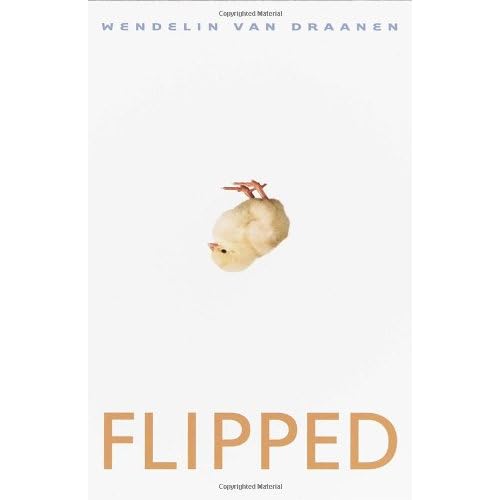
A few months ago, Kim-Mermaid and I did a book exchange, where we lent each other ten or so of our favorite YA books to read. Among these ten was a worn, much-loved (by both Kim and her children) copy of a 2001 MG novel called FLIPPED, by Wendelin Van Draanen. Now, I don’t read too much Middle Grade, but I have frequently been charmed by the magic worlds of this genre, so I was more than willing to give it a try.

Oh. My. God.

This book sucked me in on the first page and wouldn’t let me go until long after I finished the last page. Told in the alternating first-person viewpoints of a thirteen-year-old boy and girl, it is more or less a story of a first crush. Julianna falls in love with eight-year-old Bryce’s blue eyes when he moves into the neighborhood, but he finds her, at best, annoying. When eighth grade rolls around, and he finally starts to notice her, she’s no longer sure she’s interested. Sound pretty basic?

Perhaps. But the characters! The voices! So poignant, so distinct, so charming, so REAL. I finished the book, and I thought, “I will never be able to write a book like this in a million years. I might as well give up writing right now.”

Interestingly enough, I had this reaction to exactly one other book this past year, and it was also a light, charming contemporary YA. This is not to say I didn’t read other beautifully-written, well-crafted, superbly-paced books in the last year. I did. But they didn’t intimidate me. In fact, they inspired me to learn more and work harder and continue to improve my craft. So why did I have this reaction to this book?

My theory is because the strengths of this novel are so very different from my own. Whereas I feel like I can continue to improve in the areas of writing and craft and pacing and plot, I feel a bit at a loss when it comes to being “charming.”

pintipThis insight was pretty critical for me. It kept me, after all, from giving up on writing. 🙂 It may be true that I’ll never be able to write a book like FLIPPED, but there’s room for lots of different books and lots of different stories in this world.

What about you? Have you ever had this reaction to a novel? If so, why do you think that is?

Also, if you haven’t read FLIPPED, I highly recommend you pick it up. Or if MG just isn’t your thing, suggest it to any of the preteen/teen girls in your life. I guarantee they will love it


What’s Your Love Language?

What’s your love language?

The holidays are a time of love, but if we aren’t careful, it can be dominated by one particular form: gift-giving.

Gift-giving, however, is not the only way people have of expressing their affection. According to Dr. Gary Chapman, there are five love languages — five ways people have of showing love — and we all have our primary and secondary languages. http://www.5lovelanguages.com/

1. Gift-giving. Selecting (or making) just the right gift for the one you love.

2. Acts of service. Doing things to make the life of your loved one easier or better, such as cleaning the kitchen.

3. Quality time. Spending time together.

4. Words of Affirmation. Saying “I love you” or giving a compliment.

5. Physical touch. Hugging, kissing, holding hands, etc.

Continue reading

My Beloved Smart Phone

Many things can transform a writer’s life. Finding a great critique partner. Joining a community of supportive writers. Taking an eye-opening class on craft.

All of these things have happened to me in the last year or two. But one of the biggest differences in my writing life, from a decade ago to now, lies in a technological advance. That’s right: the smart phone.

Some of you may know that I can’t type away at a keyboard the way a regular writer does. Writing longhand with pen and paper is even a stretch. The only option that used to be available to me was voice recognition.

Until last year, when I started writing on my smart phone. More specifically, I send email messages to myself. Each message contains a scene or chapter, and I save it as a “draft” until I’m happy with the section. Then, I send the message to myself and transfer the section to Microsoft Word, which is the only time I touch my laptop these days.

I also lock the keyboard in “portrait” position. Believe it or not, the keys on an iPad or even in an iPhone “landscape” position are too far apart for me to handle without considerable pain.

This new method has Changed. My. Life.

Here’s why:

1. More time to write.

No more waiting for the moments when my house is completely silent. Even the sound of the shower running used to interfere with my speech recognition program. Okay, maybe that just means my shower was way too loud, but still.

Now, I can whip out my phone and write anywhere. Waiting in line, taking public transportation, lying under the sunshade at the beach. Those five minutes here and there really add up.

2. Convenience.

No more lugging around that laptop while I travel. This summer, I went on a two-week trip across the country and ocean. This fall, I’ve gone on several weekend trips in the States. My poor shoulders really couldn’t handle the heavy laptop bag. So I didn’t bring it.

Instead, I saved every chapter of my manuscript as a separate document on a word pad app on my iPhone, and I was able to continue revising my story as normal. I didn’t have to worry about leaving the laptop in my hotel room. And there were no issues with crowding my fellow passengers on the airplane.

3. Increased productivity.

Alethea-mermaid had a post this summer about how she feels less pressure to get it “right” when she’s scribbling in a notebook. Same idea here. What can be less intimidating than drafting an email? Especially an email to myself? Instead of wasting time worrying if I have the right words, I just write. And I don’t even have to carry around notebooks or loose pages or paper napkins.

My smart phone was particularly useful this past month, when I participated in — and won –NaNoWriMo for the first time. I rank my phone right up there with writing sprints and supportive mermaid sisters in helping me “write with abandon.”

4. “I’m a writer!”

The biggest advantage of the iPhone method is that it makes me feel like a writer. Yes, I got used to voice recognition. I became proficient at linking my brain to my mouth. But I never became truly comfortable with dictating my crappy first draft words OUT LOUD, even if there was no one else in the room.

Some writers are auditory learners. They prefer to hear the words rather than read them. Others don’t mind dictating their thoughts.

Not me. I love the written word. I love to sit in a moment of quiet contemplation, with the text on the page as my only company. Now, with my iPhone, I can finally write the way I’ve always wanted.

If you’ve never tried writing via smart phone, I urge you to give it a try. You might just fall in love.

I’ve written my last two novels this way. With the continual advance in technology, who knows  how I’ll write future novels?

What is your favorite way to write? In what ways has the smart phone changed your life? Who else desperately wants the iPhone 5 as a present this holiday season?
 

Moving Day

A house is a lot like a manuscript.
Sometimes, you have to tear it apart.


Rebuild it bit by painstaking bit.


Make more decisions than you ever thought possible.
Experience a series of delays, mistakes, and set-backs.
Drop your head into your hands and wonder, seriously and sincerely, if you will ever finish.
Push forward nonetheless.

And then, months or maybe even a year later, you have a completed product.

People say, “It’s like a brand new house/book!”
To which you reply: “It was totally worth it.”

Why Your Manuscript Is Not Like Your Baby

Over the years, I’ve heard writers compare their manuscripts to their babies and talk about how birthing a book is similar to birthing a baby. Having had two babies myself, I don’t agree with the comparison.

But I get it. The story is your passion, your heart, your soul. You sacrifice for the story, you pour countless hours into the story, you shed blood, sweat, and tears because of the story. No wonder the analogy of child and childbirth comes to mind.

However, I think it can be dangerous to think of your manuscripts as your children, and here’s why.

1. Your manuscript isn’t perfect, just the way it is.

Imagine if someone came up to you and said: “Your daughter is delightful, but it would be great if you could make her nose a little smaller, and I’d really prefer that she express an interest in gymnastics rather than art, and while you’re at it, maybe you can make her a boy instead?”

You would understandably be outraged and declare that even if you could change any of those things, you wouldn’t. This should not be the case with your manuscript. You may love your story, but you should be willing to tear it apart, eliminate entire sub-plots, combine two characters into one, or rewrite the entire thing.

We (or at least I) are jealous of the natural writer, the one whose words flow effortlessly from their minds, the one who has an ingrained gift for storytelling. They do exist. (Probably). Just as some people are born with perfect pitch, I am sure there are people who are born understanding conflict, with an impeccable sense of pacing, and who can pull lovable, memorable characters straight from their imaginations. Sadly, I am not one of them. The rest of us mere mortals should remember that stories aren’t born. They have to be made.

2. You’re allowed to have favorites.

When my first child was born, I secretly believed that she would be my favorite. I could not fathom ever experiencing the love I had for her for anyone else. Well, guess what? I was wrong. My son was born, and lo and behold, I love him just as much. It completely blew my mind, but there it is. I could love more than one person “to the depth and breadth and height my soul can reach.” (Elizabeth Barrett Browning).

This may be true about your manuscripts. But it doesn’t have to be. And in some cases, it shouldn’t be. Some of our first novels are merely that — first attempts. You may love a story, but if it’s not working, don’t be afraid to abandon it to move on to the next one. Conversely, don’t forgo a story too quickly, without giving it a chance to mature. Pick your favorites, and invest your time and energy into nurturing those ones into reaching their full potential.

3. You don’t ever have to be done with the whole writing thing.

At some point in our lives, either for physical or emotional reasons, most of us are done with childbirth or having babies. Not true with writing. We don’t have to write our first novel by a certain age. And we don’t have to stop writing when we reach a particular birthday. We can start writing at any time, and we can keep writing until the day we die.

I hope I do.

What do you think? If manuscripts are not babies, then what are they?